You watch a coaching video, write down five tips, and queue up trying to apply all of them. You lose. The next day you win. What worked? No way to tell: you changed everything at once, and a single game moves so much on its own that it says almost nothing. We measured how much.
The rule
One skill at a time, judged over several games, never over one.
What separates you from the next rank is a short list
The Fogbreak Academy has 40 concepts. Not all of them separate your rank from the next one. The program only keeps a skill when, at your rank and role, players one rank up clearly do it better, and players at your rank who do it well win at least 4 points more often. Iron through Diamond, that rule keeps between 2 and 7 skills per rank and role.
For a Silver mid laner, it keeps 6: CS at 10:00, farm up to 14:00, farm after laning, first and second item on time, and clearing enemy vision. On top of those come the survival basics, which go with winning at every rank without separating one rank from the next (see Do Diamond players actually die less?).
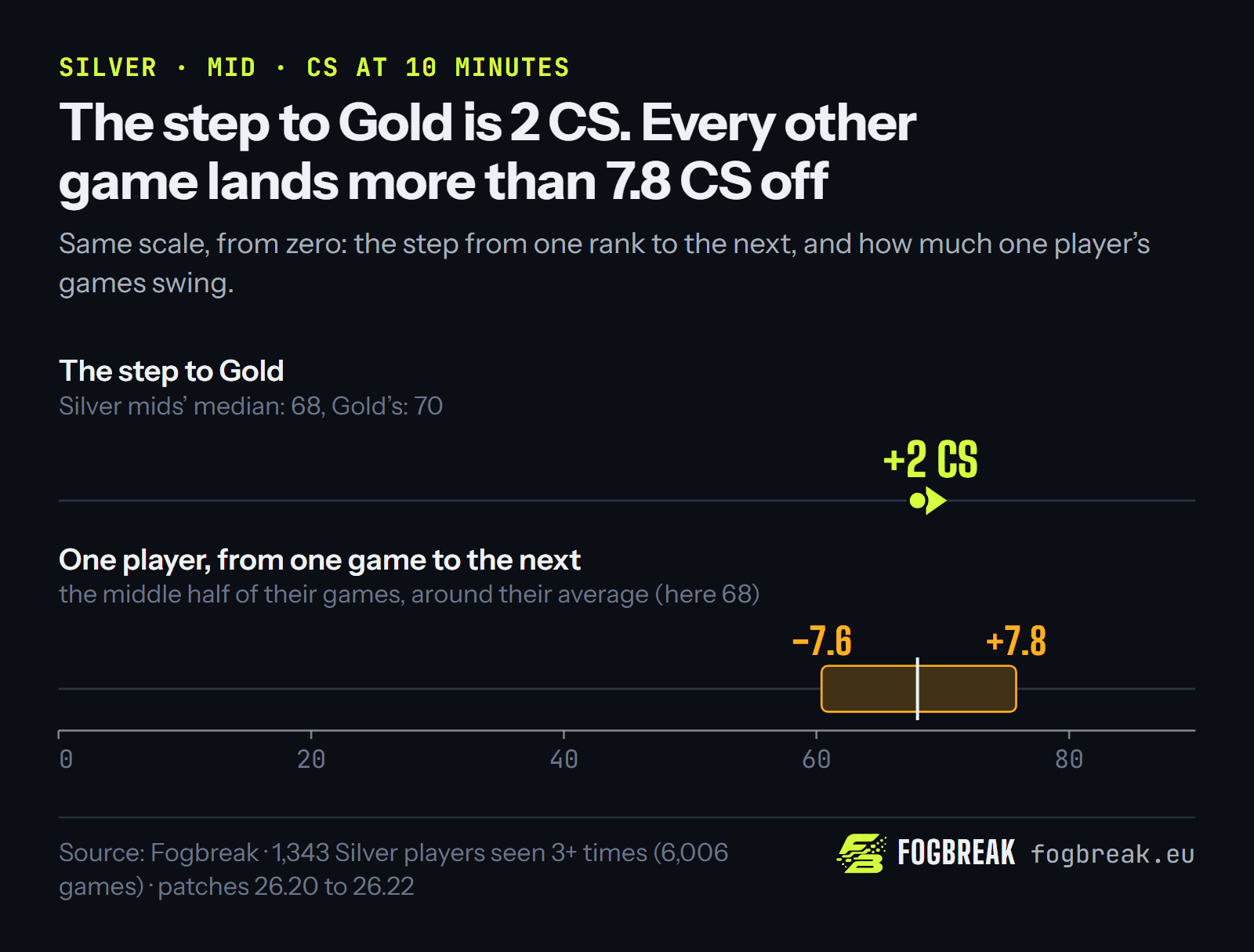
And each step is small. On CS at 10 minutes, the median moves 1 to 4 CS from one rank to the next, Iron through Emerald. Silver to Gold: 2 CS in top, 2 in mid, 3 for ADCs.
One game proves almost nothing
Your own games move a lot more than that. We followed players seen at least 3 times in the same role and rank, and measured how far each game lands from that player’s own average. In Silver (1,343 players, 6,006 games), the standard deviation is 11.3 CS, and half the games fall between 7.6 CS below the player’s average and 7.8 CS above it. Same at every rank: 11.3 to 11.5 CS, Iron through Diamond.
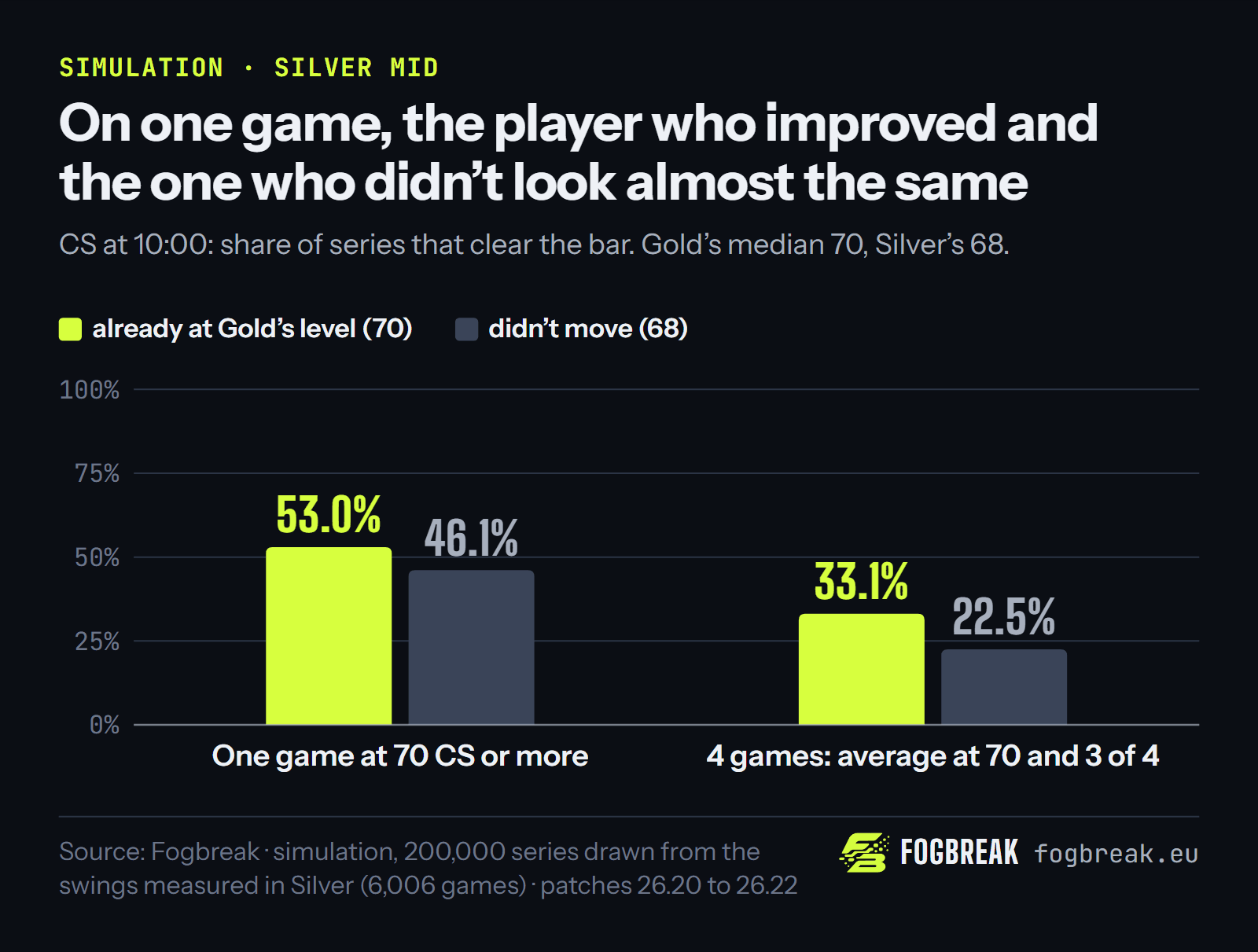
We simulated two Silver mid laners, 200,000 times each, drawing their games from the swings actually measured in Silver. The first already plays at a Gold mid’s level (70 CS at 10:00), the second hasn’t moved (68).
On one game, only 6.9 points separate them. Even a 4-game rule misses the player who improved two times out of three, and gets fooled by more than one in five who didn’t. A 2 CS step only shows up once the games pile up.
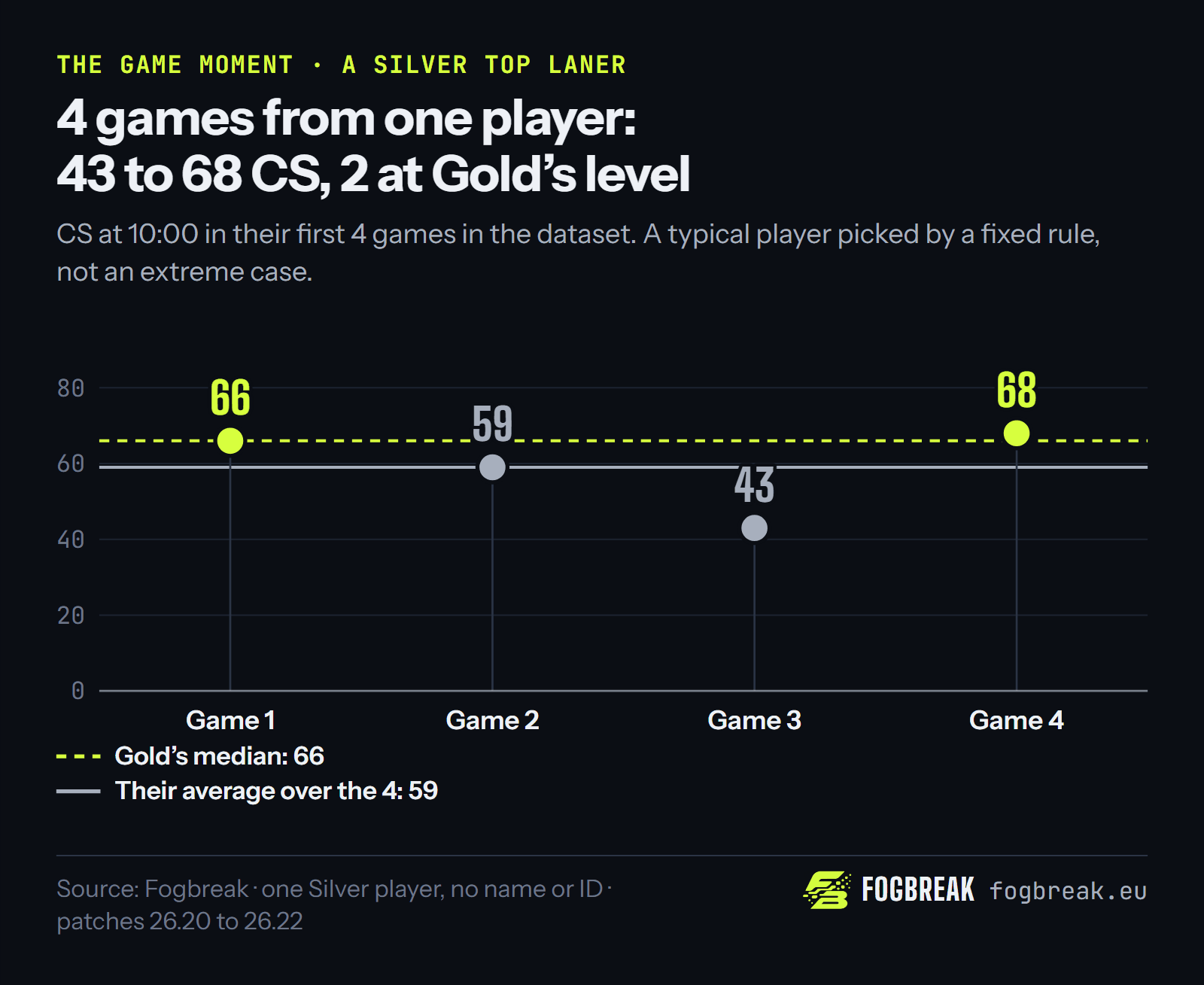
A real Silver top laner from the dataset, picked by a fixed rule: among Silver players seen 4 times or more in the same role, the one whose game-to-game swings look most like their rank’s. A typical player. Their first 4 games, at 10:00: 66, 59, 43 and 68 CS.
Judge them on game 4 and they farm like a Gold player (68, with Gold’s median at 66). Judge them on game 3 and they’re way behind (43). Neither: 25 CS separate their best and worst game, and their average (59) sits below their own rank’s median (64).
One skill at a time, picked from the ones the rule keeps at your rank and role.
The target: the level of the rank above, measured on its players.
“Locked in” as soon as you hit your target in 3 games: a first milestone you can see quickly.
“Muscle memory” later, once your next games show it holds, and only where the rank above really does better. That’s the answer to the chart above: a handful of games can’t prove it.
Followed afterwards: a reminder if it starts slipping.
What the data doesn’t measure: that people learn better one thing at a time. That’s a coaching choice, with a simple reason behind it: if you change one thing and your number moves, you know where it came from.
Mistakes at your rank
Drawing conclusions from one game. A Silver mid laner who hasn’t improved hits 70 CS or more at 10:00 in 46.1% of their games in the simulation. One good game doesn’t prove progress, one bad game doesn’t prove a slump.
Working on everything at once. A Silver mid laner’s program has 12 skills, survival basics included. All at once, and there’s no telling which one moved what.